Tuesday, July 23, 2013

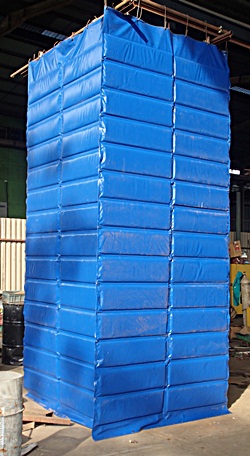
NOISE BARRIER BLANKET BY NOISESORB (M) SDN. BHD.

BACK VIEW OF NOISE BARRIER BLANKET
INSTALLED ON SCAFFOLDING
NOISE BARRIER BLANKET
LYING ON THE FLOOR FULLY SPREAD OUT
FRONT VIEW OF NOISE BARRIER BLANKET
 INSTALLED ON SCAFFOLDING


NOISE BARRIER BLANKET
 ROLLED UP


Noise barrier walls are commonly installed along roads and highways to mitigate traffic noise pollution to homes build  adjacent to such infrastructure. With increase traffic volume the traffic generated noise levels have measured to be above 80 dBA levels. These noise levels are above EPA standards and noise barrier walls appear to be one of the proven traffic noise level reduction solution.

In the hope to reduce traffic volume and to provide an alternative transportation system to the population, Malasia is now expanding the LRT routes and constructing new MRT and BRT systems. Such infracture are constructed in densely populated areas and due to time constrain construction are frequently around the clock. These construction contribute additional noise to residents, schools, hospitals etc as heavy machine are employed at the Job sites.

To comply to EPA requirements contractors installed temporary type noise barrier walls. These walls can be easily dismantled and move from one site to another. Besides the temporary metal type noise barrier walls here is another alternative introduced by Noisesorb (M) Sdn. Bhd. The use of NOISE BARRIER BLANKET is a better alternative as it is cheaper, lighter, flexible and easier to install and dismantle saving time and money for the contractor. The noise reduction is tested to be between 20 to 40 dBA

There are two (2) types of NOISE BARRIER BLANKETS whereas one is a "NOISE BLOCKER" or barrier the other is also a  "NOISE ABSORBER" with noise absorbent characteristics. Normally the noise barrier blankets are water proof as it can be either hung from a wall or installed on an independent floor mounted steel frame at the construction site. Noise barrier blankets can also be of the HEAT RESISTANT type used to cover equipment such as compressors, pumps and blowers where the motor generate both noise and heat. The noise blankets are also suitable for other industrial plants, printing press, HVAC systems,
drilling machine and piling machine.

Please contact us for more information on these products:
NOISESORB (M) SDN. BHD.
Lot 16, Jalan Sabak Bernam, Sek 26, Hicom Shah Alam. Tel:603-51914216 Fax 603-51914217
Websites: www.noisesorb.com, Email: sales@noisesorb.com
You can also call our Sales Manager Mr. How at his hand phone 6012-2088228


Friday, October 21, 2011

Flyover to despair - The Malay Mail

Flyover to despair


IKRAM ISMAIL
SITI NURSURAYA ALI
Lee Pei Yuenn
Friday, April 1st, 2011 10:09:00
Duke
TOO CLOSE FOR COMFORT: The distance between the highway and residential land, and the narrow access road (below), allow only one vehicle to pass at a time
SYLVESTER NAVARATNAM, a resident in Tiara Titiwangsa, previously known as Kampung Baru Air Panas, says the concessionaire of DUKE highway, Kesturi, denied residents their rights when constructing the highway six years ago.
"They denied our rights by acquiring public roads without going through the proper procedure such as a public hearing....more
To whom it may concern:

My son is doing a science fair project on highway noise barriers. He is comparing the efficacy of innovative noise barriers in terms of reductions of noise levels. He is a 6th grade honors science student at American Heritage School in Plantation, Florida. While searching the web, he came across your website. He was quite impressed with the aesthetic value and the practical value of your aluminum louvered metal absorption panels and and acoustic hollow masonry hollow blocks noise wall barriers. Would it be possible to obtain a sample of your product? Also, would it be possible to obtain any test data you may have comparing your product with other similar products? Your help would be greatly appreciated. If you have questions, please feel free to call me at xxx-xxx-xxxx or you may e-mail me at xxxxx@msn.com. Thank you so much, in advance, for your help.

Sincerely,
Ann Patel

Friday, May 6, 2011

Noise Barrier for Construction Sites

Noise generated from construction machine such as piling hammer, hacking machine, compressors, excavators, earth diggers and trucks used to move earth always create noise. These forms of noise pollution are especially bad and sever if the construction sites are just next to existing houses, bungalows, schools, hospitals, condominiums or apartments.

In most countries now it is a requirement that builders, developers and contractors are required to install some form of noise barriers to reduce noise pollution from construction sites instead of using the normal steel or timber hoarding during the construction period. These noise barriers have to be light, easy to install and non costly as it has to easily attached to existing scaffolding or steel tubular hoarding structures. At the end of the construction these noise barriers can be dismantled and moved to the next construction site and reused. For more information on these construction site noise barriers, its specifications and methods to install these noise barriers please contact  www.noisesorb.com


These images show the front view, back view, close up view of the view facing the construction site and the final image shows the clamps to attach these noise barrier panels to existing tubular steel structures or scaffolding. Very important are the fact that these noise barrier panels reduce both transmission loss (STC) and the open louvers allow sound absorption (NRC) by the sound absorption infill which may be either glass wool or rock wool.

Tuesday, November 30, 2010

PEOPLE LIVING NEAR TRAIN TRACKS

People living near tracks blast loud trains - and LIRR agrees

BY JESS WISLOSKI DAILY NEWS STAFF WRITER
Sunday, September 23rd 2007, 4:00 AM

Train whistles are romantic fodder in folk songs and literature, but for those who live near the Long Island Rail Road, bone-jangling horn blasts from passing trains have increasingly become an unromantic nuisance.

Complaints against the country's largest commuter rail are at an all-time high, but LIRR officials say they can't lower the horn volume because of federal regulations.

So they're trying to change the rules themselves.

"Friends, neighbors - everywhere I go, people talk to me about the horns," LIRR President Helena Williams told the Daily News.

"In this day and age when you have noise pollution everywhere, people are sensitive about the length and pitch of our horns. They have some legitimate concerns," she conceded.

Homeowners who bought properties next to railroad tracks said they were prepared for a small nuisance, but a recent increase in horn volume and more frequent use has tipped their sanity scales, they said.

"It's like you're being assaulted," she said. "You acclimate yourself to noise in this city, but this is too much."


Some blame the LIRR's new trains as the culprit for their worsening woes, but the agency noted that the fleet, which was fully replaced early last year, is operating at the federally required minimum loudness.

But that may change soon.

"We're seeking a waiver so we can lower the decibel of the horn," as well as reducing the sequence of blasts, said Williams, who said the LIRR is also testing new technology.

A 2005 Federal Railroad Administration mandate amped up horn use rules at crossings, and raised the minimum volume to between 96 and 110 decibels.

The LIRR wants an exemption, so it can lower it to the previous level of 92 decibels. Every 3 decibels means a doubling of loudness.

"The problem is when you use the horn in a dense area, it reverberates off all the residential buildings and multiplies exponentially," Williams said.

For Jack Mevorac, a Long Island attorney, the news arrived right on time. He founded the Train Noise Abatement Association after the new rules drowned Cedarhurst, with five street-level crossings, in 1,200 blasts a day.

"It's not a quality-of-life issue, it's a health crisis," said Mevorac, who routinely wears earplugs.

After demonstrations by his group, engineers and media outlets logged readings of 109 to 119 decibels in his town.

"We have already crossed the point where everybody agrees they're too loud," he said. "Everyone at least is moving in the right direction."

Read more: http://www.nydailynews.com/ny

Friday, November 26, 2010

Train Noise Reduction

Summary of Initial Train Noise Study
China Project - Shenzhen 2/28/2000
Sephir Hamilton

Recommendations
  1. Install continuous traffic barrier near train tracks.
  2. Use heavy wall construction with no openings or seams.
  3. Use heavy-paned, non-opening, double-glazed windows (at least 3" air space).
  4. Seal all cracks, joints, and discontinuities in the wall (especially window mounts).
  5. Minimize the wall (flat wall) and window areas (small windows) on the exposed side.
  6. Build a continuous structure adjacent to the tracks to block the rest of the site (taller is better).
  7. Situate bedrooms on "quiet-side," living and dining rooms in the middle, and kitchen/bath and common areas on the exposed side.
  8. Place no vents or other openings through the exposed wall.
Explanations ...read more here


Train Noise Reduction

Summary of Initial Train Noise Study
China Project - Shenzhen 2/28/2000
Sephir Hamilton

Recommendations
  1. Install continuous traffic barrier near train tracks.
  2. Use heavy wall construction with no openings or seams.
  3. Use heavy-paned, non-opening, double-glazed windows (at least 3" air space).
  4. Seal all cracks, joints, and discontinuities in the wall (especially window mounts).
  5. Minimize the wall (flat wall) and window areas (small windows) on the exposed side.
  6. Build a continuous structure adjacent to the tracks to block the rest of the site (taller is better).
  7. Situate bedrooms on "quiet-side," living and dining rooms in the middle, and kitchen/bath and common areas on the exposed side.
  8. Place no vents or other openings through the .....read more here